This past weekend, another attack was carried out against Jewish Americans. A man, Mohamed Soliman, threw an incendiary device into a crowd before turning a homemade flamethrower on them. The victims were part of “Run for Their Lives,” a group that walks weekly to raise awareness about Israeli hostages still held by Hamas. According to the FBI, Soliman was shouting “Free Palestine” during the attack.
Not long before that, Elias Rodriguez was arrested for the murders of Yaron Lischinsky and Sarah Milgrim, both staffers at the Israeli embassy. According to federal agents, he shouted “Free Palestine” and said he “did it for Gaza.”
In recent months, there have been multiple reports of ICE detaining pro-Palestinian protesters, many of whom are here on valid visas. Mahmoud Khalil, a graduate student at Columbia University and legal U.S. resident, was arrested after organizing campus demonstrations. Mohsen Mahdawi, another Columbia student, was detained at what he believed was a citizenship interview. Leqaa Kordia, a Palestinian woman, was arrested during a protest and had her sealed NYPD records shared with ICE in violation of sanctuary policies.
Then there’s Rümeysa Öztürk, a Turkish PhD student at Tufts University. After co-authoring an op-ed critical of Israel’s actions in Gaza, she was abruptly detained by ICE. No charges, no hearing—just silence, isolation, and uncertainty. Imagine the fear of being taken not for a crime, but for your voice. In each of these cases, officials invoked “antisemitism” as justification—even when there was no hate speech involved, only dissent.
For starters, what Soliman and Rodriguez did was abhorrent. The detainment and bullying of pro-Palestinian protesters by the Trump administration is abhorrent. The 50,000-plus deaths of Palestinians caused by the Israeli government is abhorrent. And the October 7th, 2023, attack and subsequent kidnapping of hostages by Hamas was abhorrent. Each of these acts, perpetrated by different actors on different sides, represents profound harm against real people—people who are not the cause of the suffering being fought over.
In all these cases, lives have been lost or destroyed. It shouldn’t matter if they are Muslim or
Jewish, Israeli or Palestinian. I know that’s no radical statement—but somehow, it still feels rare. Too many people have drawn hard lines around whose grief they are willing to hold. The deaths of some become global tragedies; the deaths of others are met with silence, or worse, a defensive shrug. There’s a fracture forming—a separation in how we see humanity, depending on the flag behind the pain.
The Trap of Taking Sides

Sometime last year, I was talking with a friend when the subject of Palestine came up. She’s of Middle Eastern descent and was deeply grieved by the mass killing of Palestinians. That didn’t surprise me—she’s thoughtful, informed, and engaged. What did surprise me was her reaction when we discussed the October 7th Hamas attack. Instead of acknowledging the horror of that day, she framed it as an understandable response to years of Palestinian oppression by the Israeli government. When I gently tried to push back, she shut the conversation down. For her, Palestinian suffering was beyond debate—but the suffering of Israelis, even civilians, was something she could set aside. I think she was trying to preserve our friendship, afraid that disagreement might break it.
That interaction has stuck with me—not because it was unique, but because it’s become painfully common. So many people have drawn hard lines: either you support Israel or you support Palestine. Show empathy for one side, and you’re accused of betraying the other. Criticize Hamas, and you’re labeled a Zionist. Criticize the Israeli government, and you’re branded antisemitic. There’s no room left for nuance, no space for grief that holds more than one truth.
But the truth is: all griefs are valid. And this binary thinking—this forced choice—only deepens the wound. It redirects our outrage away from the systems and leaders responsible for violence and towards each other. Civilians become stand-ins for regimes. The rage meant for militaries and governments lands instead on a Jewish clergyman out for a walk, or a Muslim university student unlocking her car.
We must refuse that dichotomy. We can and should condemn both Hamas and the Israeli government for their roles in this violence. We can mourn for those killed in Gaza and those killed in Tel Aviv. And we must build a world where it’s not radical to say that no life is disposable—no matter whose flag is flying above it.
This polarization doesn’t just warp our empathy—it distorts our language too. Nowhere is that more clear than in the way the word antisemitism has been used in recent months. A term that once named real, dangerous hatred is now being stretched to include legitimate dissent, peaceful protest, and even grief for Palestinians. When language is bent like this, it doesn’t protect people—it shields power. And it leaves Jewish safety and Palestinian liberation both more vulnerable in the process.
Weaponizing Words

In its most literal sense, antisemitism is prejudice or hatred toward Jewish people as a group. But the word carries much more than just its dictionary meaning—it evokes one of the darkest periods in human history. For many, it immediately brings to mind the Holocaust: gas chambers, mass graves, the haunted faces of starving survivors. It holds a collective moral weight, and rightly so.
That’s why it’s important to be precise. Antisemitism is not the same as anti-Zionism. The former targets Jewish identity and existence; the latter opposes the political ideology of a Jewish state and the actions of the Israeli government. What we’ve seen in most pro-Palestine or “Free Palestine” protests in the U.S. has largely been anti-Zionist—not anti-Jewish. Protesters are speaking against policies, not people.
Even in the most extreme and abhorrent examples—like the attacks carried out by Mohamed Soliman and Elias Rodriguez—the violence appears to have been politically, not religiously, motivated. Soliman attacked demonstrators calling for the release of hostages held by Hamas. Rodriguez killed two Israeli embassy staff. These actions were appalling and indefensible. But from what’s publicly known, they weren’t expressions of hatred toward Judaism itself. That distinction matters—not to excuse, but to understand.
Some may call that splitting hairs. But definitions are important—because powerful actors are weaponizing this confusion. When the Trump administration detains immigrants for speaking out about Palestine and labels them “antisemitic,” they’re not protecting Jewish safety. They’re using a sacred term to shield political power. Take the case of Tufts student Rümeysa Öztürk: detained after publishing an op-ed critical of Israeli policy. No hate speech. No violence. Just words. And still, punished.
Meanwhile, Israel’s government has killed over 60,000 Palestinians since October 7th, 2023, according to Al Jazeera. Over 100,000 more have been injured—mostly civilians. In many cases, entire buildings were bombed based on intelligence that Hamas may have been inside. Civilian casualties weren’t just accepted; they appear to have been calculated. And yet, when critics speak out, they’re often silenced under accusations of antisemitism.
This language has become a smokescreen—one that hides state violence, deflects scrutiny, and discourages dissent. The Trump administration has leaned into this confusion deliberately. Their motives aren’t rooted in protecting Jewish communities; they’re rooted in consolidating control. By labeling immigrant protesters as “antisemitic,” they frame dissent as danger. They push a narrative that anyone who questions the Israeli government is a threat, and in doing so, they justify surveillance, detention, and the erosion of civil liberties.
This fits a broader pattern. The same administration has spent years vilifying immigrants, using rhetoric eerily similar to 1930s Germany—painting outsiders as dangerous, disloyal, and un-American. They’ve sought to reshape universities into tools of ideological conformity, punishing students and faculty who don’t align with their worldview. And they’ve shown unwavering support for Netanyahu and the Israeli government’s campaign against Palestinians. For them, the term “antisemitism” isn’t about stopping hate—it’s about silencing opposition. It’s about making sure the muddy waters of dissent stay too murky for most people to wade into.
Twisting Grief Into Power
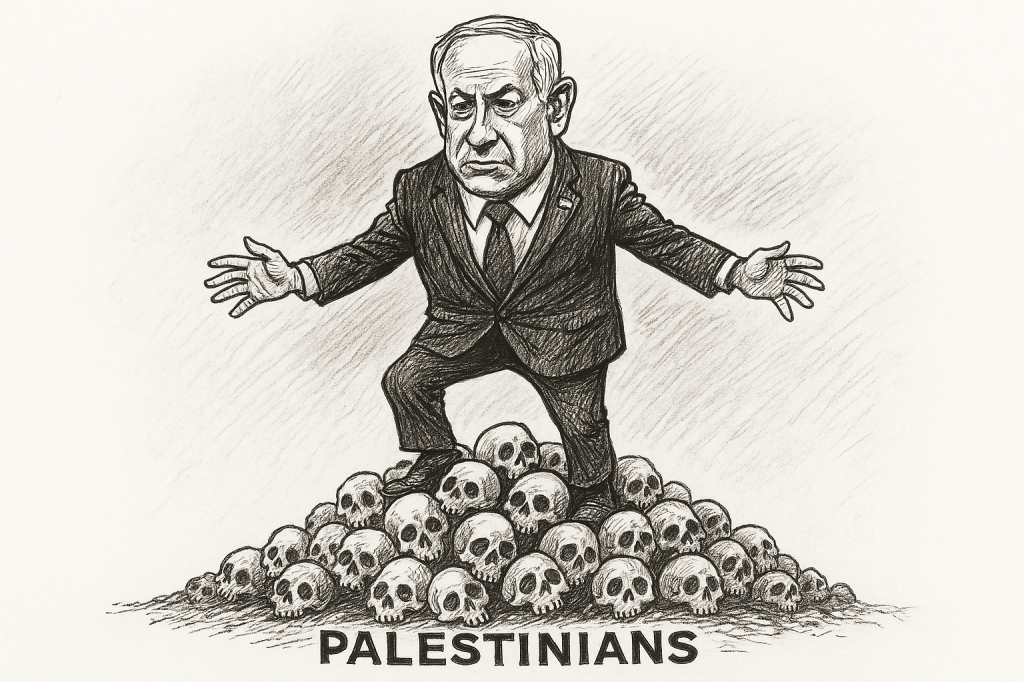
It’s possible—necessary, even—to hold multiple truths at once. We can and must condemn violence against Jewish people wherever it occurs. The trauma of antisemitism, both historical and ongoing, deserves serious reckoning. Jewish communities have been targeted for centuries, and that pain didn’t end with the Holocaust. It continues through threats, vandalism, attacks on synagogues, and fear that never fully goes away. Acknowledging that is not a distraction from justice—it’s part of it.
But recognizing that pain doesn’t mean ignoring another. The Israeli government’s actions in Gaza—mass bombings, displacement, blockades of water and food—are not acts of self-defense. They are part of a long pattern of violence and control over the Palestinian people. Calling that genocide isn’t antisemitic—it’s a moral response to systemic harm. And ignoring it in the name of protecting Jewish safety doesn’t make anyone safer. It just trades one silence for another.
Netanyahu’s record helps us understand how we got here. His leadership has repeatedly escalated tensions through policies that have deepened Palestinian suffering. He has championed the expansion of settlements in the West Bank, often in violation of international law, and dismissed the possibility of a Palestinian state. These actions have not only destabilized the region but have also entrenched divisions that make peace feel increasingly out of reach. Each policy has compounded the pain of an already displaced population.
Understanding Netanyahu’s current motivations also requires looking at the political pressures surrounding him. His governing coalition includes far-right, ultranationalist parties that demand increasingly aggressive action. At the same time, Netanyahu is facing multiple corruption charges and a growing legitimacy crisis at home. Maintaining power means satisfying his hardline base—through military escalation, territorial control, and opposition to Palestinian sovereignty. These choices are not only morally devastating but also politically strategic. They serve his survival, not the safety of all Israelis.
What Comes Next Must Be Different
So why does this matter—on a blog focused on automation, economics, and the future of society? Because the future isn’t just shaped by technology. It’s shaped by the stories we tell, the people we trust, and the lines we draw between who belongs and who doesn’t. No amount of innovation can save us if we carry old systems of division into new worlds. And few conflicts illustrate that danger more clearly than the one between Israel and Palestine.
The future we imagine here is one rooted in human rights, not ethno-nationalism. We believe in a world where basic dignity is guaranteed—not bought, not earned, not held hostage by your nationality, religion, or politics. That vision can’t coexist with leaders who thrive on fear and control. Figures like Netanyahu and Trump don’t just abuse power—they manipulate pain. They twist grief into division. And they use our worst instincts, our tribal loyalties, to keep us from seeing the systems that truly harm us.
I won’t pretend peace is simple. It may never come fully. But what we can do—what we must do—is reject the language of division and look toward the language of repair. When we speak with care, when we name injustice precisely, we make it harder for the powerful to weaponize our empathy. Even those who think these global conflicts don’t touch them are starting to feel their reach. Surveillance, silencing, detainment—it doesn’t stop at the border. And it never will.
If we want a future that belongs to all of us, we have to build it on shared humanity. Not through sides, but through solidarity.
This moment calls for clarity, compassion, and courage. We must condemn violence, protect free expression, and demand better from the leaders who act in our names. We can support Jewish safety and Palestinian freedom without contradiction. We can reject antisemitism and state violence. And we can choose a future not ruled by fear, but built on dignity, justice, and truth.
If this resonated with you—or challenged you—I invite you to share your thoughts. Disagreement is welcome here, but hate is not. Let’s speak to one another like the future depends on it.
Sources:
Associated Press. “Boulder Flamethrower Attack Investigated as Terrorism.” AP News, 2 June 2025. Link.
ABC News. “Boulder Attack Suspect in U.S. Illegally, Homeland Security Says.” ABC News, 2 June 2025. Link.
Reuters. “Two Israeli Embassy Staffers Killed in Washington Shooting.” Reuters, 22 May 2025. Link.
Times of Israel. “Washington Shooting Suspect Told Police He ‘Did It for Gaza.’” The Times of Israel, 23 May 2025. Link.
NPR. “Immigration Agents Arrest Palestinian Activist at Columbia Protests.” NPR, 10 Mar. 2025. Link.
PBS NewsHour. “Arrest of Palestinian Activist Will Be ‘First of Many,’ Trump Says.” PBS NewsHour, 10 Mar. 2025. Link.
Offenhartz, Jake. “NYPD Shared a Palestinian Protester’s Info with ICE. Now It’s Evidence in Her Deportation Case.” AP News, 6 May 2025. Link.
Reuters. “U.S. Immigration Officials Ask Pro-Palestinian Cornell Student to Surrender.” Reuters, 21 Mar. 2025. Link.
Florido, Adrian. “Tufts Student Rümeysa Öztürk Freed from Immigration Detention.” NPR, 9 May 2025. Link.
“Turkish Student at Tufts University Detained; Video Shows Masked People Handcuffing Her.” AP News, 27 Mar. 2025. Link.
Al Jazeera Staff. “Israel-Gaza War in Maps and Charts: Live Tracker.” Al Jazeera, 9 Oct. 2023. Link.
Human Rights Watch. A Threshold Crossed: Israeli Authorities and the Crimes of Apartheid and Persecution. HRW, 27 Apr. 2021. Link.
Amnesty International. Israel’s System of Apartheid against Palestinians. AI, 1 Feb. 2022. Link.
The New Yorker. “The Hostage War: How Netanyahu Propped Up Hamas.” The New Yorker, 22 Jan. 2024. Link.
PBS NewsHour. “Netanyahu’s Government Vows to Expand West Bank Settlements.” PBS NewsHour, 2025. Link.
Times of Israel. “For Years, Netanyahu Propped Up Hamas. Now It’s Blown Up in Our Faces.” The Times of Israel, 2024. Link.

 Replicators After Stock Markets
Leave a comment